

There exists within the Cartier archive a particular lineage of objects that transcend their mechanical function to become pure expression of design philosophy. The Panthère represents one such lineage. When Louis Cartier commissioned George Barbier to create the “Dame à la Panthère” in 1914, he established a symbolic language that would shape the Maison’s creative direction for over a century. That iconic feline, born from the imagination of the House’s most visionary patrons, evolved from a delicate decorative motif into something far more profound: an emblem of power expressed through form, of elegance distilled to its essential gestures. What began as a pattern rendered in onyx and brilliant-cut diamonds would eventually become the signature of an entire design philosophy, one intimately bound to the vision of Jeanne Toussaint, the woman Louis Cartier himself christened “La Panthère” for her formidable creative presence.


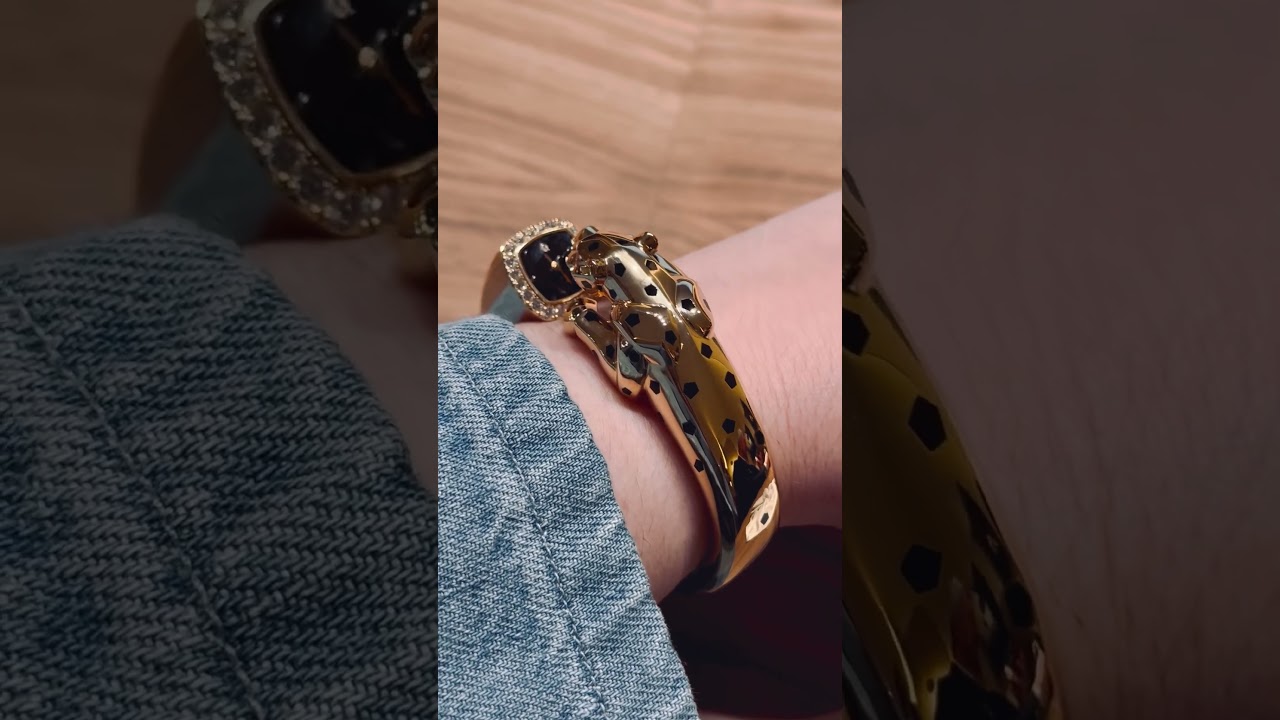
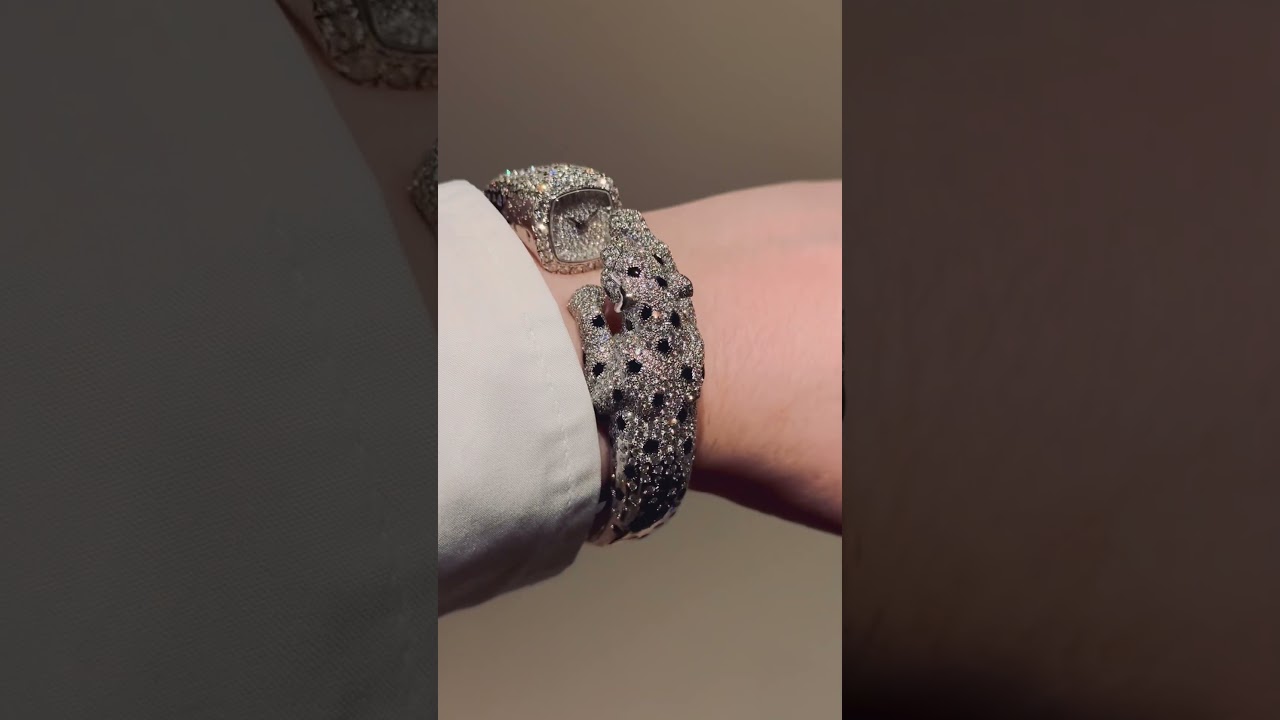
The Panthère Jewellery Watch, unveiled at Watches and Wonders 2025, represents the apotheosis of this historical trajectory. Here, at last, Cartier resolves a tension that has animated its practice for decades: the fundamental duality between watchmaking instrument and jewellery object. This timepiece does not merely blur the boundary between these two disciplines; rather, it dissolves the boundary entirely through an architectural proposition that is nothing short of audacious. Presented as a bangle rather than a conventional wristwatch, the Panthère Jewellery Watch embraces the “Toi & Moi” format, a French tradition of jewellery design wherein two discrete yet complementary objects occupy a shared plane. On one side of the bangle leaps a three-dimensional panther, rendered in precious metal and finished with brilliant gemstone accoutrements. On the opposite terminal sits a delicate watch dial, framed and adorned, positioned as the conscious counterpart to the animal’s unconscious grace.


Luminosity as Structure
The dial of the white gold iteration presents itself as a study in the manipulation of light through ordered geometry. The entire surface receives a snow-set treatment, the diamonds compose a continuous, almost abstract field. This is not diamond paving in the conventional sense, where gemstones emphasise the underlying form. Rather, the diamonds function as the primary structural element, their carefully calibrated arrangement creating a plane that exists simultaneously as both tactile surface and luminous void. The eye encounters a dial that appears to dissolve into crystalline luminescence, yet the indices and time-telling function remain perfectly legible beneath this jewelled curtain.

The white gold base upon which these diamonds rest reflects the overarching design principle: precious metal becomes the substrate for light’s refraction rather than a display surface in its own right. Every angle of every diamond has been positioned to catch and return ambient illumination in a choreographed fashion, transforming the simple mechanical act of reading time into an almost meditative exercise in visual perception.

The yellow gold variant adopts a contrasting approach, one rooted in graphic composition rather than luminous dissolution. The dial receives a black lacquer finish, a technique that demands extraordinary precision in application and curing. Against this absolute darkness sits a single brilliant-cut diamond, positioned at the twelve o’clock hour marker, where it functions both as a functional time reference and as a sculptural accent. The black lacquer absorbs light rather than reflecting it, thereby amplifying the singular brilliance of the diamond through pure contrast. This represents a fundamentally different aesthetic proposition, one that privileges clarity of line and boldness of chromatic statement.

Quartz as Practical Discretion
The Cartier Panthère Jewellery Watch houses a quartz movement, a technical specification that warrants genuine appreciation rather than the dismissive attitudes that certain quarters of horological society reserve for non-mechanical power systems. The quartz calibre provides hours and minutes with entirely reliable precision, functions calibrated to deliver the temporal information required by its wearer. The decision to employ quartz rather than mechanical movement speaks to a clear design hierarchy: the visual and tactile architecture of the bangle itself takes absolute precedence over any display of horological complexity.

Consider the implications of this choice. A mechanical movement, with its perpetual requirement for careful handling and regular servicing, would introduce an element of functional anxiety into an object designed as pure jewellery. The case must remain slender enough to function as a bangle; the bracelet must maintain the proportions that allow it to sit elegantly upon the wrist; the visual weight must be distributed so that the panther and the watch dial achieve an equilibrium of visual presence. A hand-wound mechanism, with its external crown and jewelled decoration, would compromise each of these requirements. A self-winding rotor would introduce additional thickness and asymmetrical visual mass. The quartz movement, operating silently, requiring no external manipulation, permits the designer to concentrate on form and material entirely unobstructed by mechanical pragmatism.

The Case: Precious Metal as Architectural Language
The case of the Panthère Jewellery Watch encompasses dimensions of 150, 160, or 170 millimetres circumference, specifications that directly reference the geometry of the human wrist and the traditions of jewellery-making rather than the watch industry’s conventional case diameter measurements. This shift in descriptive language signals a fundamental reorientation: the designer thinks not of “watch cases” but rather of “jewellery forms.”

The white gold iteration presents an unrelenting surface of precious metal and brilliant gemstones. The entire case receives the snow-set treatment, the same diamond-paving technique applied to the dial, creating visual continuity across the entire object. The panther itself occupies the space that a conventional watch case would reserve for the “12 o’clock” position, though such terminology becomes meaningless in the context of a bangle that serves no directional orientation. The feline emerges from white gold, its body rendered in a sculptural manner that captures both the animal’s musculature and its characteristic grace. Emerald eyes, cut and polished to capture light with particular intensity, gaze outward with an almost sentient quality. The spots and nose consist of onyx, and here Cartier employs a technique of extraordinary refinement: metal is folded around each onyx stone in such a fashion as to suggest the texture of fur, creating an illusion of actual animal coat rendered in precious materials. This approach elevates the representation beyond mere symbolism into a realm of technical virtuosity.

The yellow gold version adopts a thoroughly different aesthetic. The base metal receives a polished finish, allowing yellow gold’s warm luminosity to dominate the visual field. Against this golden ground appear black lacquer spots, applied through a process demanding absolute precision in both application and curing. The panther’s eyes become tsavorites, those brilliant green garnets that possess a particular vibrancy absent in more conventional emeralds. The nose remains onyx, rendered through the same fur-setting technique. A single brilliant-cut diamond, positioned at the watch dial’s twelve o’clock position, provides a further chromatic accent and reinforces the visual hierarchy of the composition.

Both versions maintain the water resistance specification of 30 metres (3 bar), a practical acknowledgement that jewellery watches, despite their primary function as objects of adornment, must remain serviceable in daily use. This specification reflects a balanced philosophy: protection sufficient for normal handling and occasional water exposure, but not the operational theatre or heavy-weather scenarios for which industrial tool watches are engineered.

The Object and Its Meaning
The Panthère Jewellery Watch occupies a territory that contemporary watch design rarely explores with conviction. It rejects the conventional taxonomy that separates “dress watches” from “sports watches,” “tool instruments” from “fine jewellery.” Instead, it presents a synthesis rooted in historical precedent and contemporary refinement. The “Toi & Moi” format, drawn from a French jewellery tradition extending back centuries, introduces a narrative element absent from most contemporary horology. The panther and the dial exist in conscious dialogue with one another, each affirming the other’s presence through juxtaposition.

This architectural proposition commands contemplation. The watch wearer experiences not a single unified object but rather a deliberately composed duality. The panther reminds the wearer of power, grace, and untamed beauty. The dial represents civilised time itself, the measured progression of human moments. These two entities, arranged upon a shared plane, speak to the tension between nature and civilisation that has animated artistic practice since the Romantic era. Cartier has seized upon this historical dialectic and rendered it in precious metals and brilliant gemstones, creating an object that functions as both practical timekeeper and philosophical argument about the nature of adornment.
The technical precision brought to every surface of this bangle speaks to a design culture that respects its audience’s intelligence. Every diamond has been individually selected and positioned. Every lacquer application has been monitored for consistency. Every emerald eye and onyx accent has been cut to exacting specification. The result is an object that rewards prolonged examination, revealing layers of craftsmanship that only become apparent through patient observation.

For those who possess the sensitivity to understand that a watch need not compromise its jewellery function to maintain horological integrity, and who further appreciate that time-telling can exist within a context of pure aesthetic expression, the Panthère Jewellery Watch represents an achievement of considerable distinction. It succeeds because it recognises a fundamental truth that industrial design too often forgets: that form and function need not conflict if the designer approaches each with genuine conviction and technical mastery. It is hard to explain the emotions one feel when studying the dynamic presentation of the Panthère Jewellery Watch. The tactile feel of feline proeminent musculature and the superb execution of Cartier‘s artisans. I always loved the Maison’s interpretation of the panther motif and these watches do not disappoint.


