

Ninety-four years after polo-playing officers stationed in British India challenged the watch industry to create a timepiece capable of surviving their favourite pastime, the Reverso continues to evolve while maintaining absolute fidelity to its Art Deco origins. Jaeger-LeCoultre’s 2025 interpretation of the Reverso Tribute Monoface Small Seconds arrives dressed entirely in 18-karat pink gold, paired with a Milanese link bracelet that transforms this dress watch icon into something altogether different. The result occupies a peculiar position: vintage glamour delivered through contemporary execution, sporty origins expressed through jewellery-like presence.
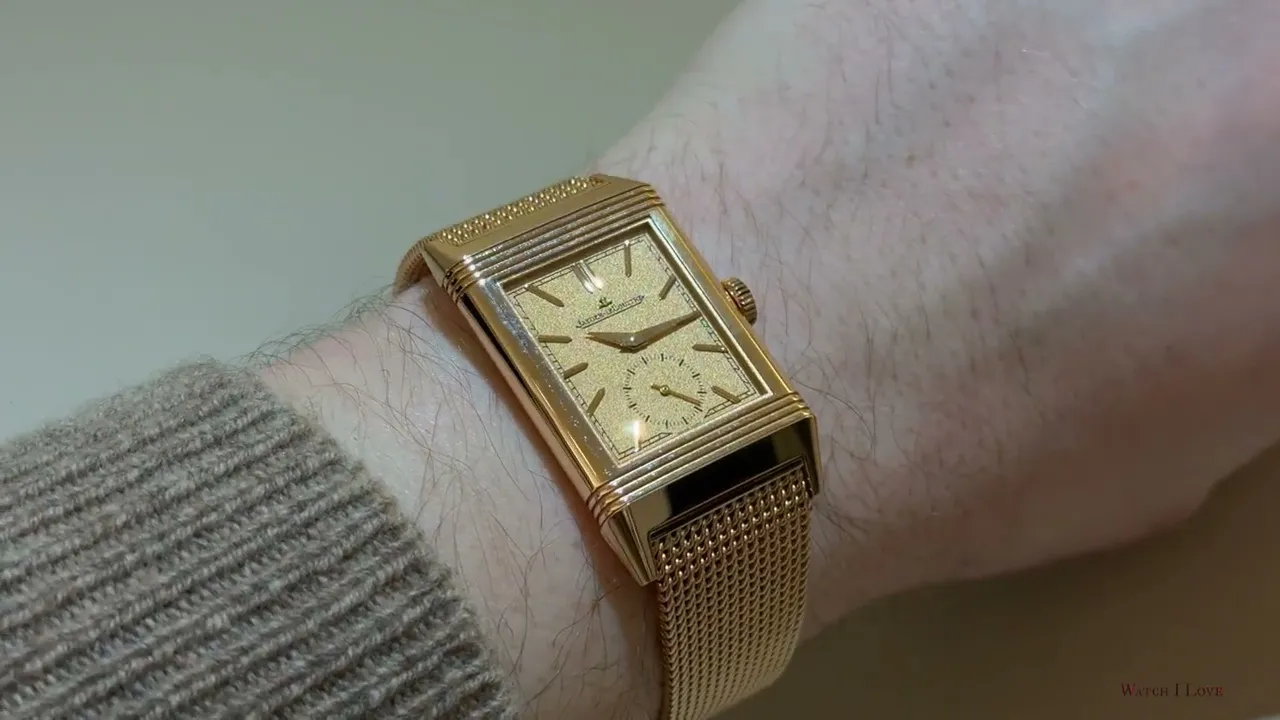

What makes this particular Reverso so compelling is the cohesion between every visible element. The case, bracelet, and dial share the same warm golden palette, yet each surface treatment creates distinct textural contrast. This is watchmaking that rewards close inspection, where the details accumulate into something genuinely considered. I was lucky to see it way before Watches and Wonders, before the official launch and… I love it!

Golden Grain Against Polished Metal
The dial of the Reverso Tribute Monoface Small Seconds presents a masterclass in surface treatment and visual balance. Executed in a golden hue that perfectly matches the surrounding pink gold case, the dial receives its character through multiple stamping operations that create a finely grained texture. This matte, textured finish provides the essential counterpoint to the high polish present elsewhere on the watch, ensuring that the hours remain legible against an otherwise monochromatic composition.

The overall layout recalls the purity of the 1931 original Reverso, with applied indexes marking the hours rather than numerals. These indexes deserve particular attention. Their elongated shape and faceted profile add visual depth to the dial surface, catching light at varying angles and providing a luminous contrast against the matte grain of the background. The faceted treatment echoes the form of the Dauphine hands, creating a deliberate visual dialogue between the two elements. Both hands and indexes share the same polished finish, ensuring consistent legibility whilst maintaining aesthetic harmony.

At six o’clock, the circular small seconds subdial introduces welcome geometry to an otherwise linear composition. The circular track serves as a counterpoint to the rectangular case and straight dial elements, breaking the rigid Art Deco lines with a touch of classical watchmaking tradition. The black-coloured minutes track and subdial markings provide crisp contrast, enriching the gold-toned design without disrupting the overall serenity.

The railway minutes track follows the contours of the case, framing the dial in a manner that emphasises the rectangular geometry whilst adding visual depth to the composition. Every element here demonstrates considered restraint; there is nothing superfluous, nothing demanding attention for its own sake.

The Movement: Calibre 822
Beneath the solid caseback resides the Jaeger-LeCoultre hand-wound Calibre 822, a movement that has served the Reverso collection for approximately three decades whilst receiving quiet updates along the way. This calibre represents something increasingly rare in contemporary watchmaking: a movement shaped specifically to suit its case rather than the inverse.
The Calibre 822 comprises 108 components and operates at a frequency of 21,600 vibrations per hour, providing a power reserve of 42 hours from a single barrel. The movement measures a scant 2.94mm in thickness, a dimension that proves crucial in achieving the watch’s slim 7.56mm profile. The jewel count has evolved over time; earlier iterations specified 21 jewels, whilst current versions employ 19 jewels following the adoption of a free-sprung balance wheel and revised balance cock design.

The tonneau-shaped architecture of the Calibre 822 follows Jaeger-LeCoultre‘s philosophy of product integrity, where movement shape should correspond to case shape. Every component of this movement was designed, produced, and assembled entirely within the manufacture in Le Sentier, a claim that fewer houses can make with each passing year.
The decoration applied to the Calibre 822 follows classical Geneva finishing conventions. The bridges receive Côtes de Genève (Geneva stripes), applied in parallel bands that create subtle plays of light across the surfaces. Edges receive bevelled treatment, with hand-finishing applied to the anglage work on visible components. Polished screw heads provide points of concentrated reflection, whilst the overall presentation, whilst not approaching the theatrical complexity of the manufacture’s high-complication movements, exceeds the minimum requirements for optimal function by a comfortable margin.
The replacement of the traditional Triovis regulator with a free-sprung inertia balance represents a significant technical evolution, allowing for finer rate adjustment and improved long-term stability. This modification, though invisible to most owners, demonstrates the manufacture’s commitment to incremental improvement rather than wholesale reinvention.

Fifty Components of Considered Engineering
The Reverso case remains one of watchmaking’s most complex enclosures, comprising over 50 individual components, of which approximately 40 serve the slide-and-swivel mechanism alone. This mechanism, derived from René-Alfred Chauvot’s original 1931 patent, allows the watch capsule to rotate 180 degrees within its cradle, originally enabling wearers to protect the crystal during polo matches by presenting the solid caseback to the outside world.

The 2025 Reverso Tribute Monoface Small Seconds measures 45.6mm x 27.4mm, with a thickness of 7.56mm. This profile represents a refined execution of the Reverso silhouette, slim enough to slip beneath a shirt cuff whilst substantial enough to announce its presence on the wrist. The case is crafted entirely from 18-karat pink gold (750/1000), providing the warm, slightly rosy hue that distinguishes this alloy from yellow gold.

The signature horizontal gadroons adorning the top and bottom of the case trace directly to the original 1931 design, themselves drawn from the Art Deco architectural movement prevalent during the Reverso’s creation. These decorative grooves serve no functional purpose beyond aesthetic delight, yet they define the Reverso’s identity as surely as the reversing mechanism itself.

The Milanese Bracelet
The Milanese link bracelet transforms this Reverso into something unexpected. Crafted from no fewer than 16 metres of pink gold threads, the bracelet construction employs a dense, flat metal weave made from two intertwined threads, creating a double layer of small interlocking links. This assembly forms a fabric-like structure known as pezza, providing exceptional flexibility whilst maintaining structural integrity.

The bracelet’s origins trace to thirteenth-century Milan, where similar techniques were employed for chain mail armour. Renaissance goldsmiths later adapted the method for jewellery, though the technique remained largely unknown outside Italy until German jewellers mastered it in the 1920s, sparking an international fashion. The style returned to prominence in the 1970s, when Milanese link became fashionable for watch bracelets, and now enjoys another revival thanks to its ability to appear sporty or elegant according to context.

The final steps of bracelet manufacture involve stamping each link to precise dimensions and hand-soldering each side, link by link. The absence of pins in this construction ensures exceptional durability and that characteristic smooth, sinuous feel on the wrist. An integrated sliding clasp allows for precise fit adjustment, whilst the polished 18-karat pink gold buckle complements the shiny surface of the links.

The lug attachment has been modified on this model so that the bracelet appears integrated with the case, eliminating the visual gap that sometimes afflicts metal bracelets mounted to rectangular cases. This attention to integration exemplifies the difference between good and excellent execution.

Bold, Beautiful, Desirable
The Reverso Tribute Monoface Small Seconds in pink gold with Milanese bracelet occupies a space that few watches successfully claim. It is simultaneously vintage and contemporary, a jewellery piece that traces its lineage to sport, a rectangular dress watch that drapes around the wrist with fabric-like suppleness.

What impresses most about spending time with this watch is the absence of compromise. Every surface treatment, every material choice, every proportion has been considered in relation to every other element. The matte grain of the dial demands the polish of the case for contrast. The slim profile of the Calibre 822 enables the thin case. The modified lugs allow the bracelet to integrate seamlessly.

The Reverso has housed 79 different calibres and accumulated 39 patents across its nine decades. It has been reimagined countless times, occasionally straying towards complication for complication’s sake. This version returns to essentials: three hands, a seconds subdial, and exceptional materials finished with evident care.

Having spent considerable time with the Reverso Tribute Monoface Small Seconds (in comparison with the other press pieces), it has firmly established itself as one of this year’s favourites. The tactile pleasure of that Milanese bracelet, the warmth of pink gold catching afternoon light, the satisfying click of the swivelling mechanism as the case rotates within its cradle, these are the experiences that distinguish fine watchmaking from ordinary timekeeping. La Grande Maison has delivered something genuinely special here: an icon renewed without revision, a classic allowed to be itself.

Jaeger-LeCoultre Reverso Tribute Monoface Small Seconds Technical Specifications
Ref. Q713216J – CHF 37’800 / 44 100 € / £ 37600 / US$ 44,400 / ¥ 340,000 / HK$ 328,000 / ¥ 6,600,000 / 58500 S$ / AED 163,000 / AU$ 70,000
Functions
- Seconds, Hour – Minute
Movement
- In-House Calibre 822_2
- Manual winding
- Dimensions: 22 x 17.20 mm
- Thickness: 2.94mm
- Vibrations per hour: 21600 / Frequency (HZ): 3
- Power reserve: 42 hours
- Components: 108
- Jewels: 19
Case
- Pink Gold 750/1000 (18 carats)
- Dimensions (L x W): 45.6 x 27.4 mm, L : Lug to lug
- Thickness: 7.56mm
- Water resistance: 3 bar
Dial
- Appliqued hour-markers, Golden 4n, Grained
- Hands: Dauphines
Strap & Buckle
- Pink gold Milanese bracelet
- Crafted with quick-release technology for seamless strap interchangeability


