

When Louis Moinet unveiled his innovations to the world at the 1851 Universal Exhibition in London, he established a benchmark for chronometric excellence that continues to resonate today. More than a century later, as watchmaking finds itself caught between the comfortable embrace of heritage and the electrifying demands of innovation, Louis Moinet revisits that legacy with the 1806, an observatory chronometer that carries within it the DNA of its founder’s relentless pursuit of precision.
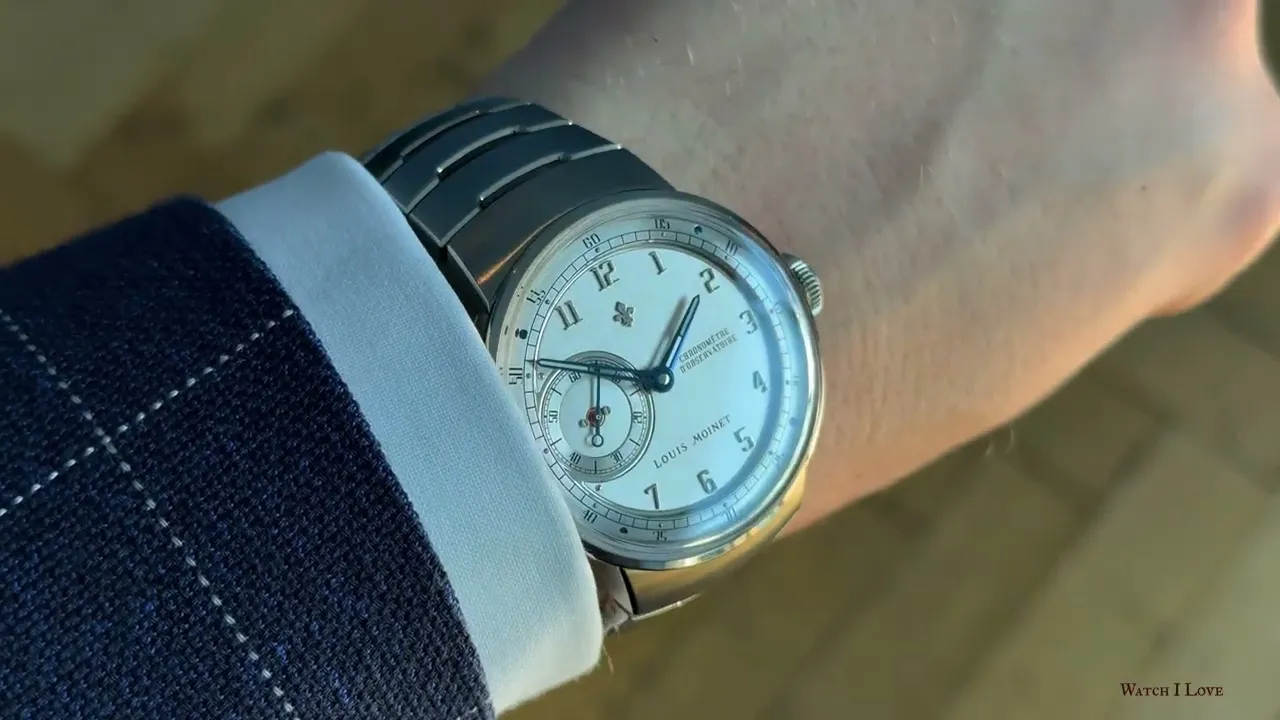

The 1806 deserves our attention not because it arrives wrapped in marketing rhetoric, but because it succeeds in a genuinely difficult feat: honouring history without becoming imprisoned by it. This is a watch that understands the value of what came before whilst refusing to remain shackled to it. It comes as a natural evolution of the 1816 Chronograph.

A Study in Historical Restraint and Contemporary Sensibility
The rhodium-plated dial presents itself with a subtle liveliness that emerges only upon closer inspection. The interplay between satin and bead-blasted finishes creates a surface that shifts in appearance depending on light angle and intensity, an effect that captures the rigorous, scientific character the 1806 aspires to embody. This is not a dial designed to seduce from across a room; rather, it invites intimate engagement, rewarding the owner’s repeated examination with layers of detail that compound appreciation over time.

The construction comprises 35 individual pieces, each contributing to the overall visual architecture. The classical, deeply engraved numerals convey the precision and clarity one would expect from a scientific instrument, while the peripheral minute flange, finished in circular satin, provides visual grounding. This flange is punctuated by twelve blackened nickel cabochons and four blued steel screws. It is a choice that speaks to historical authenticity without descending into pastiche. These elements create a visual framework that acknowledges the 19th-century origins whilst remaining visually coherent within contemporary design language.

The small seconds dial at nine o’clock receives particularly thoughtful treatment. Its bead-blasted centre, offset by a polished circular frame, creates genuine depth and clarity. The ruby-set barrel at the subdial’s centre, flanked by two polished screws, introduces a technical accent that feels both rigorous and refined – detail that separates accomplished watchmaking from competent assembly.

The typography merits specific attention. The Louis Moinet signature appears in its historic typeface, whilst the designation Chronomètre d’Observatoire employs the same font as the hour numerals, creating visual cohesion without resorting to heavy-handed design gestures. The slender, openworked hands in blued steel maintain the visual clarity that defined the original designs, whilst their tips feature SLN luminous material for practical legibility. The fine seconds hand stands apart through its circular openworked counterweight, a detail that genuinely bridges historical craftsmanship with contemporary precision without feeling contrived.

Where Science Becomes Art
Within the sapphire caseback lies the LM1806 calibre, an automatic movement certified as an observatory chronometer by the Geneva Astronomical Observatory, an institution that has maintained chronometric standards since its founding in 1772. This certification carries genuine weight. Each 1806 movement endures fifteen days of rigorous testing, positioned in varied orientations and subjected to temperature fluctuations, before receiving its certificate.

Dimensionally, the movement occupies 30.4mm diameter with a height of 6.6mm, powering hours, minutes, and seconds. The movement operates at 28,800 vibrations per hour (corresponding to a frequency of 4 Hz) with twenty-two jewels distributed throughout its construction and a forty-eight hour power reserve.

The finishing reveals the care invested in this calibre’s execution. The mainplate features circular Côtes de Genève combined with circular-grained surfaces and perlage. It is a triple decorative approach that creates visual richness without aesthetic confusion. The automatic bridge showcases perlage and diamond-cut bevelling, with the Louis Moinet symbols engraved and gilded directly into the component. This is finishing intended to be observed through the caseback, and it rewards such observation.

The bimetallic oscillating weight demands particular attention. The design represents a purposeful evolution from conventional approaches, incorporating a ball-bearing with six balls and secured through blued steel screws. A fleur-de-lys appliqué adorns the rotor, a reference to Bourges, Moinet‘s birthplace, transforming a functional component into a personalized element. The openworked and gold-plated design reveals the individual movement number as it rotates, simultaneously guaranteeing authentication and offering visual theatre.

Directoire Silhouette in Titanium
The case draws inspiration from history’s very first chronograph yet achieves its own identity through material and proportion. The Directoire-style semi-bassine silhouette, highlighted by the double gadroon detail, combines the sobriety of historical lineage with the contemporary lightness of grade 5 titanium. The case measures 40.6mm in diameter with a height of 15.15mm, proportions that sit comfortably between tool watch practicality and dressy sophistication.

The material choice of grade 5 titanium warrants explanation beyond mere specification. Titanium offers corrosion resistance superior to steel whilst providing substantially reduced weight, enabling a watch of genuine substance to feel remarkably light upon the wrist. The polished and satin-brushed finishing creates surface variation that captures light dynamically, creating visual interest as the watch moves against the skin.

The crown, engraved with a fleur-de-lys, acknowledges Moinet‘s connection to Bourges with restrained elegance rather than ostentatious symbolism. The sapphire crystal incorporates double anti-reflective treatment, essential for the legibility a scientific instrument demands.

Water resistance reaches 50 metres, a specification that affirms this watch’s civilian rather than professional diver credentials. The 1806 represents a timepiece for individuals who understand themselves as cultured observers of time’s passage, not as individuals requiring sports watch capabilities.

The bracelet, christened the BRIDGE project, represents Louis Moinet‘s inaugural titanium bracelet design. Its distinctive wide links evoke a stylised bridge whilst maintaining contemporary sensibility. The alternating satin and polished surfaces create visual movement, and crucially, the links flow fluidly into one another, enabling the bracelet to sit naturally against the wrist without disrupting the watch’s overall balance. The integration between bracelet and case achieves near-seamless transition, a refinement that demonstrates genuine attention to how the complete assembly functions as a coherent object.

Continuing a Story
The 1806 succeeds where many heritage-focused watches falter: it resists the temptation toward excessive ornamentation or shallow sentimentality. Instead, it represents a genuine exploration of how contemporary watchmaking might honour precision’s pioneers without becoming archaeologically frozen.

To wear the 1806 Observatory Chronometer is to participate in a narrative extending across centuries. Louis Moinet‘s dedication to exact measurement, his innovations in chronometry, his assemblage of scientists and watchmakers united in pursuit of precision, these elements find continuation within this contemporary watch. The observatory certification validates the mechanical foundation upon which that narrative rests.

This is a watch for individuals who understand that time possesses both scientific dimension and philosophical resonance, for collectors who value horizontal polish applied to every component regardless of whether observers will see it, for those comfortable with understatement as a legitimate design philosophy.

The 1806 honours its namesake’s origins: that remarkable clock created for Napoleon in 1806, a landmark work whose date inspired this present creation, whilst refusing to become merely a historical reenactment. Contemporary watchmaking at its finest does not demand that we choose between respecting tradition and embracing the present. The 1806 demonstrates that when approached with sufficient care and conviction, both become possible simultaneously. The watch rewards both casual ownership and repeated, contemplative examination, which represents the highest compliment one might pay to any instrument of time.

Louis Moinet 1806 Observatory Chronometer Technical Specifications
Ref. LM-160.20.60 – CHF 18,900 (ex. taxes)
Functions
- Hours | Minutes | Seconds
Movement
- Manufacture Louis Moinet Calibre Observatory-certified chronometer, LM1806
- Dimensions:
- Diameter : 30.4 mm
- Height: 6.6 mm
- Type Mechanical self-winding, Screw balance
- Oscillating weight: New design | Bimetallic | Openworked and gold-plated | Ball-bearing with 6 balls | Blued steel screws and fleur-de-lys applique
- Finishing:
- Mainplate: circular Côtes de Genève, circular grained, perlage
- Automatic bridge: perlage, diamond cut bevelling, Louis Moinet symbols engraved and gilded
- Wheels: circular grained
- Oscillations: 28,800 vph
- Frequency: 4 Hz
- Jewels: 22
- Power reserve: 48 hours
Case
- Grade 5 titanium, polished and satin-brushed
- Sapphire crystal with double anti-reflective treatment
- Diameter: 40.6 mm
- Height: 15.15 mm
- Water-resistance: 50 metres
Dial
- Colour: rhodium-plated
- Construction : 35 pieces
- Finishing: bead-blasted
- Markings: engraved
- 12 cabochons, black nickel
- 4 blued steel screws
- Counter: Satin-brushed ring, bead-blasted centre
- Flange: Circular satin finish
- Hands:
- Hours and minutes: blued steel, facetted and openworked, with luminescent material
- Blued steel second hand with circular openworked counterweight
Bracelet
- Grade 5 titanium, polished and satin-brushed


