

In January, Milan became the epicentre of horological ambition when LVMH Watch Week descended upon the fashion capital for its seventh edition. Held from 19 to 21 January, the event has matured into the group’s preferred laboratory for ideas, a focused platform where each maison can present its thinking without the distraction of a full-scale trade fair. Nine watchmaking houses gathered under the LVMH umbrella, amongst them Daniel Roth, now operating with full support from La Fabrique du Temps Louis Vuitton. The revival of Daniel Roth, which began in earnest in 2023, has followed a deliberate path: first came the Tourbillon, honouring the complication that defined the brand’s identity. Now, with the presentation of the Extra Plat Rose Gold Skeleton, the maison has taken its most significant step forward, moving beyond faithful reinterpretation into contemporary expression.

The Extra Plat represents something singular within Daniel Roth‘s catalogue. During his early years as an independent watchmaker, Mr. Roth considered the Extra Plat a complication in its own right. Its appeal lay not in mechanical complexity but in technical discipline. The apparent simplicity of a thin movement confined within the precise geometry of the double-ellipse case formed a foundational pillar of the brand’s reputation. For decades, this philosophy remained unchanged. The Extra Plat was never skeletonised during the brand’s founding era. That it should become so now speaks to a decisive moment in the maison’s direction: a willingness to expand its expressive range without abandoning the principles upon which it was built.

The Case: Restraint and Proportion
The Extra Plat Rose Gold Skeleton preserves the signature double-ellipse form that has been the sole case shape throughout Daniel Roth’s entire history. Measuring 38.6 millimetres in length by 35.5 millimetres in width, it follows the classical proportions of the original. What distinguishes this version is its thickness: at 6.9 millimetres, it is 0.8 millimetres thinner than the standard Extra Plat, a reduction that underscores the commitment to essential form. The case is crafted entirely from 18-karat rose gold 5N, with fully polished surfaces that maintain the elegance of the original design. Flat sapphire crystals appear on both the dial and case back sides, the latter offering complete transparency to the movement within. Water resistance stands at 30 metres reflects the watch’s identity as a dress piece rather than an instrument of utility. The calfskin leather strap, fitted with a 20-millimetre lug width, arrives in natural tone with blued steel hands that echo the classical aesthetic.

The Movement: Architecture Made Visible
At the heart of the Extra Plat Rose Gold Skeleton beats the DR002SR, a shaped movement manufactured entirely in-house at La Fabrique du Temps. This is not a skeletonised adaptation of an existing calibre, but a purpose-built reinterpretation of the original DR002 architecture. Michel Navas and Enrico Barbasini, the master watchmakers who oversee the manufacture, have redesigned the bridges and plates from first principles, creating a movement that could be rendered with transparency without sacrificing rigidity or chronometric performance.
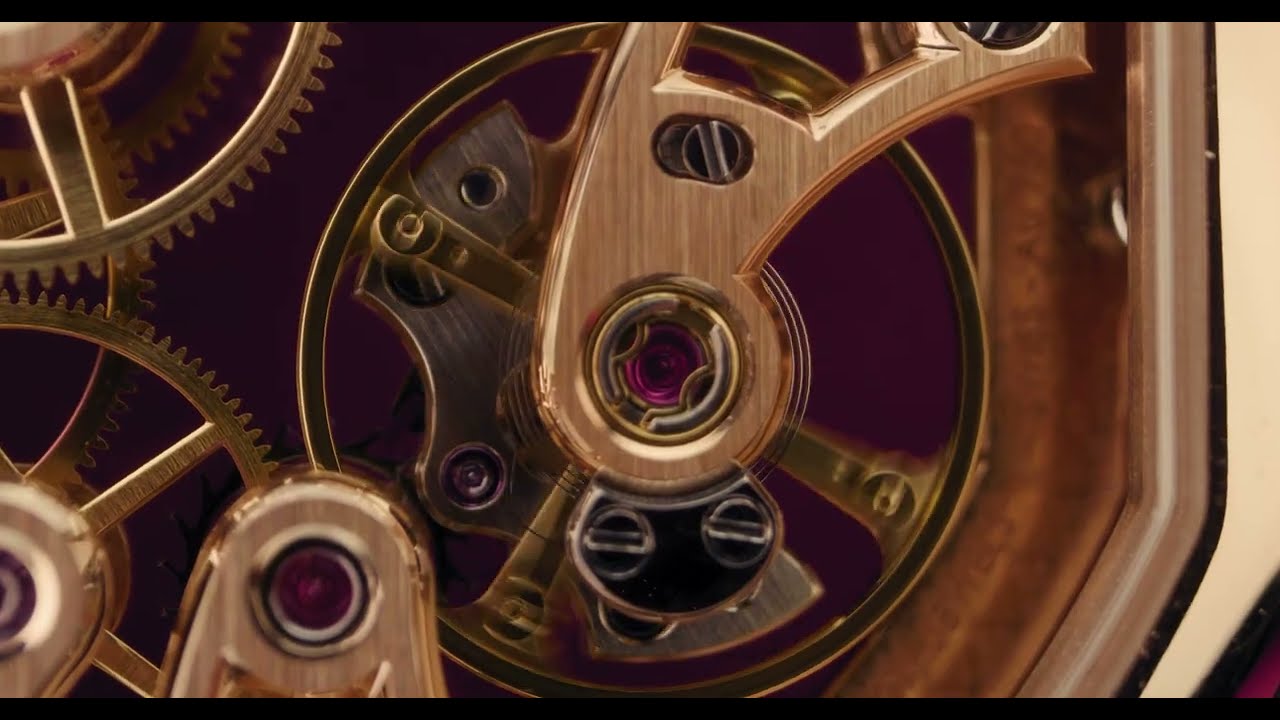

The movement measures 31 millimetres by 28 millimetres, with a thickness of 3.1 millimetres. It houses 141 components, of which 21 are jewels. The power reserve extends to 65 hours, whilst the balance beats at 4 hertz. These specifications are identical to the standard DR002, a confirmation that the skeleton variant loses nothing in practical terms. The construction itself tells a story of considered engineering. A single-piece bridge supports the gear train, its form reduced to three flowing arms with slender borders. Around the screw seats, the geometry becomes unforgiving: the clearances are so tight that tool access seems improbable, yet each sharp internal angle has been shaped and polished by hand, a work that cannot be accomplished by machine.
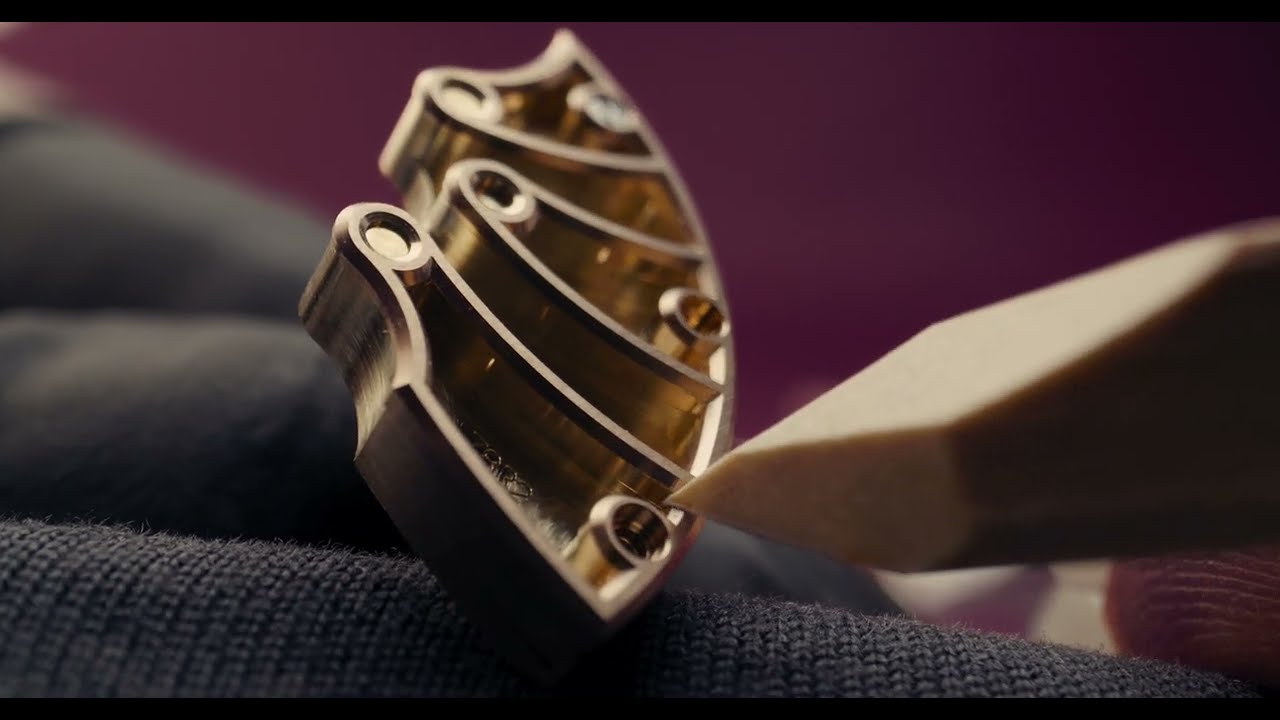
The decision to cast all the bridges and plates in solid rose gold 5N was both practical and aesthetic. Gold provides a naturally warm contrast to the black-polished steel components and offers an ideal substrate for the extensive hand finishing that characterises haute horlogerie. Enrico Barbasini has explained that gold, being a noble metal, responds beautifully to traditional finishing and allows handwork to speak clearly, essential in a skeletonised movement. The flat tops of the bridges are brushed with precision, while the edges receive continuous anglage. The undersides of the bridges, visible from certain angles, are finished with perlage, a detail that speaks to the artisanal standards maintained throughout.

The Openworked Architecture
Skeletonisation is an exercise in reduction, and the Extra Plat Rose Gold Skeleton brings this principle to its highest expression. Each sharp internal transition within the movement bears the imprint of the artisan’s hand. The main plate has been exhaustively opened, following the contours of the double-ellipse case itself, creating a visual cohesion between form and function. Where the dial-side plate would normally exist, three separate finger bridges now arch gracefully, their slender profiles emphasising the mechanical logic beneath.

The finishing throughout reflects what has become the standard in contemporary fine watchmaking: electrical discharge machining provides the starting point for the openworking, but hand finishing completes the work. The internal angles that result from this process are what distinguish a well-finished skeleton from a merely transparent one. Here, each angle has been polished with sufficient care that it catches light with clarity and precision. The contrast between the warmth of the rose gold and the coolness of the black-polished steel creates visual rhythm across the movement.

One aspect worth noting is the absence of decorative engraving on the movement surfaces. In the early skeleton work Daniel Roth himself produced during the 1990s, intricate engraving patterns adorned the bridges. Unfortunately, it is a practice that has largely fallen away in contemporary haute horlogerie. This restraint allows the structural finishing to speak without additional embellishment, a choice consistent with the brand’s philosophy of refined simplicity.

Context and Significance
The presentation of the Extra Plat Rose Gold Skeleton at LVMH Watch Week marks a meaningful evolution for Daniel Roth. The brand’s revival, which began in 2023 with the introduction of the Tourbillon collection, has proceeded with deliberation and respect for the founder’s legacy. Matthieu Hegi, Artistic Director of La Fabrique du Temps, observed that by skeletonising the calibre, “we allow the architecture to be understood on its own terms. It is a respectful evolution of what Mr. Roth first imagined more than thirty years ago.”

What distinguishes this moment is that the Daniel Roth Extra Plat Rose Gold Skeleton represents the first entirely new model conceived in the modern era of the brand’s revival. The Tourbillon reissued the original vision; the Extra Plat skeletonised reimagined it. In doing so, the maison has stepped beyond the role of custodian into that of interpreter. The movement remains faithful to the principles upon which Daniel Roth built his reputation: proportion, clarity, technical mastery. Yet it speaks in a contemporary language.

The watch will be produced in limited numbers each year at a retail price of 85,000 Swiss francs, excluding taxes. Availability began in January 2026. For collectors and enthusiasts who have followed Daniel Roth‘s journey through its various chapters, from its founding as an independent manufacture to its sojourn under other ownership, and now its revival within the LVMH framework, this timepiece offers a compelling confirmation that the brand’s direction is both thoughtful and forward-looking. It is a watch that honours what came before whilst making clear that Daniel Roth remains capable of innovation grounded in tradition.


