

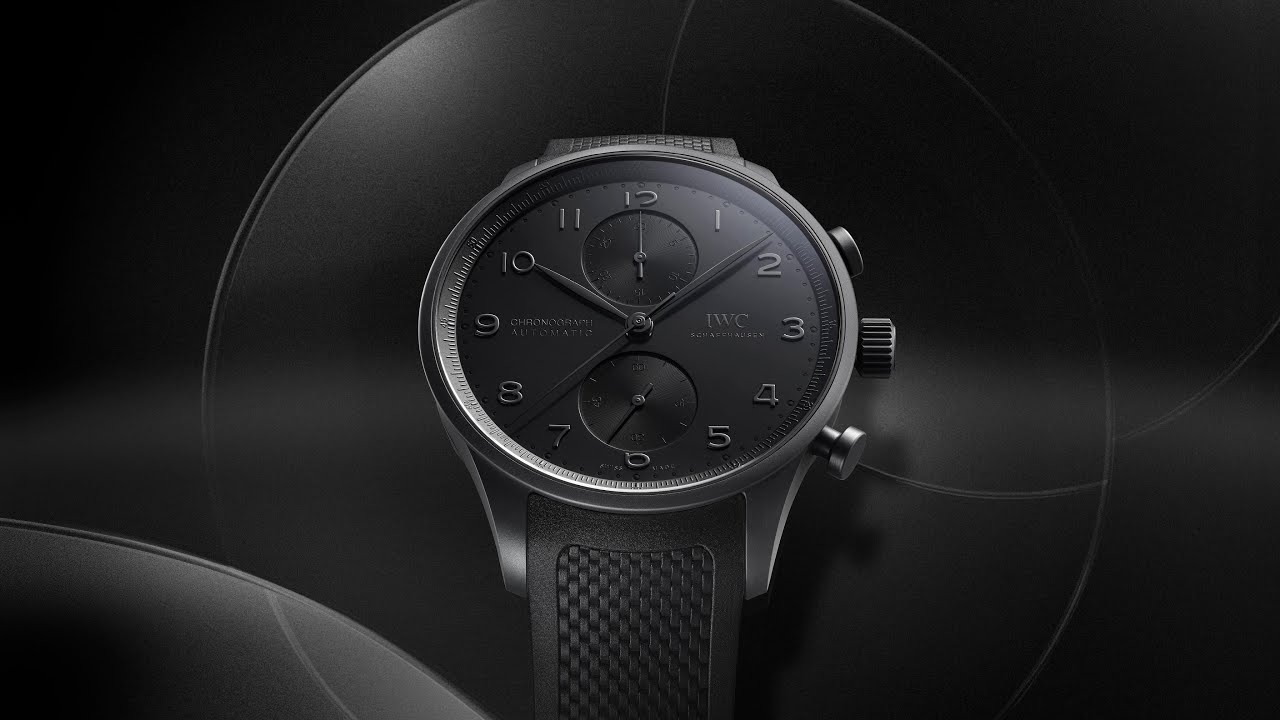

I have always had a complicated relationship with the Portugieser Chronograph. It is one of those designs that feels simultaneously safe and irreplaceable, a watch so well-proportioned that it rarely needs reinvention. Yet IWC just pulled off something genuinely surprising. Introduced on 26 February, the Portugieser Chronograph Ceratanium® (Ref. IW371631) marks the first time the collection has broken away from steel and precious metals, and honestly, it works.

The Dial — Total Blackout
The dial is where things get immediately interesting, and also divisive. IWC has gone all-in: black dial, black applied Arabic numerals, black indices, black hands, every single element is the same shade. The applied numerals and indices are physical elevations above the dial surface, so they catch ambient light and create a subtle, almost spectral relief against the background. The inner flange preserves the quarter-second scale that generations of Portugieser fans recognise instantly, here rendered in the same shadow tones. The two vertically arranged subdials, running seconds at nine and chronograph minutes at three, maintain the classic layout without any concession to legibility. That is a deliberate choice, and Christian Knoop, IWC‘s Creative Director, frames it well: the design strips the chronograph down to its silhouette, with nothing to distract the eye. I respect the conviction, even if I would want lume in certain conditions.

Calibre 69355: A Manufacture Movement Worth Examining
Flip the watch over and you find one of my favourite movements currently in production: the IWC-manufactured calibre 69355, visible through a smoked sapphire exhibition caseback. This is not a simple movement to dismiss. Developed from the ground up by IWC, it runs at 4 Hz (28,800 vph), houses 27 jewels, and delivers a 46-hour power reserve via a double-pawl automatic winding system. The chronograph architecture relies on a column wheel for start-stop-reset control, which delivers a crisper, more defined actuation than cam-based alternatives. Crucially, the constant-seconds runs directly from the fourth wheel at six o’clock, which allowed IWC engineers to integrate a horizontal oscillating-pinion clutch, a notably different approach from the vertical clutches common today, without relocating the subdial. Furthermore, the escape wheel and pallet fork use nickel-phosphorous parts fabricated via LIGA lithography, reducing mass and improving efficiency. The hacking seconds complete the practical picture.

The Case — Ceratanium® Does Its Job
Ceratanium® is IWC‘s proprietary material: a titanium alloy that undergoes high-temperature kiln firing, yielding a finish as hard and scratch-resistant as ceramic, yet as light as titanium. At 41 mm in diameter and 13.1 mm in height, the case sits well on the wrist — less imposing than you might expect given the thickness figure. The case, crown, and pushers all share the same material and the same deep matte-black finish, so there is no visual interruption anywhere on the watch. A convex sapphire crystal with anti-reflective coating on both sides covers the dial, and water resistance stands at 3 bar (30 metres), adequate for daily use. The rubber strap carries a square-pattern texture and closes with a Ceratanium® pin buckle, keeping the monolithic aesthetic intact from lug to buckle.

Final Thoughts
At €15,000 / CHF 13,000 / $14,600, the Portugieser Chronograph Ceratanium® is not cheap, but it is a genuinely limited proposition – only 1,500 pieces, and the first Portugieser Chronograph ever made in this material. For those who found the steel versions too conventional, this watch offers a real alternative with sound technical substance underneath. I think IWC played this correctly: they did not change the architecture of a beloved design; they simply darkened every surface until the form itself becomes the statement. Whether that resonates comes down entirely to personal taste, but the engineering behind the blackout is hard to argue with.


